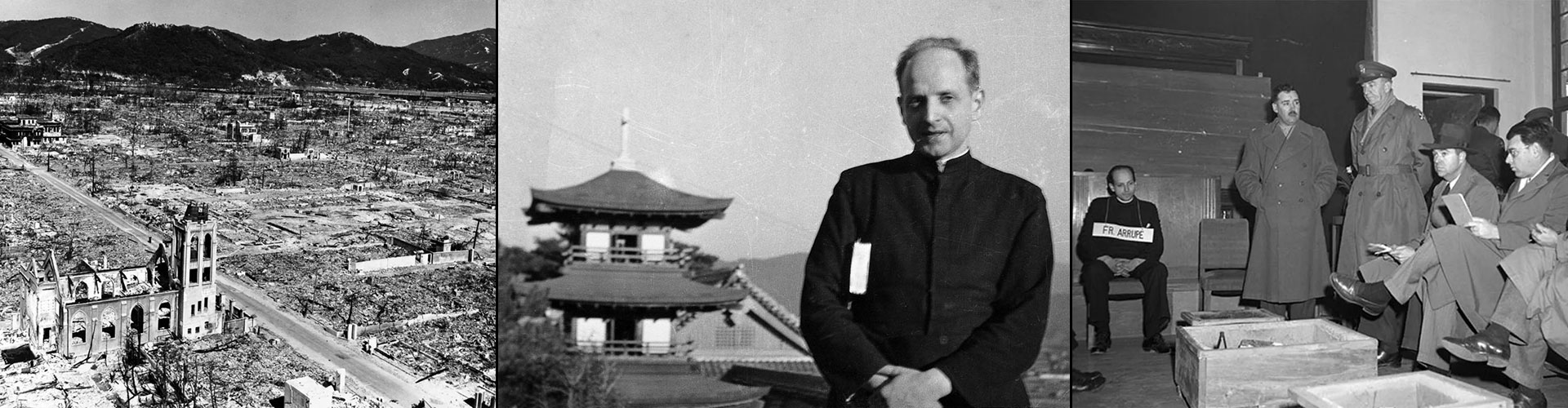
On 6 August 1945, Hiroshima was transformed in an instant by the first atomic bomb used in warfare. Among those who survived were several Jesuits whose response to the catastrophe became a remarkable story of courage, service and peace.
On the morning of 6 August 1945, Hiroshima was a city going about its ordinary business in the final months of the Second World War. At 8:15 a.m., that ordinary life came to an abrupt end when an atomic bomb exploded above the city. Buildings collapsed, fires spread rapidly, and tens of thousands of people were killed or grievously wounded.
Among those who witnessed the destruction were members of the Society of Jesus. The Jesuits had two principal houses in Hiroshima: the Catholic church and residence at Nobori-cho, close to the centre of the city, and the novitiate at Nagatsuka, situated on higher ground outside the city. The latter had been established as a place of formation for young men preparing to enter the Society of Jesus.
The Jesuit community at Nagatsuka was under the leadership of Fr Pedro Arrupe, SJ, then Rector and Master of Novices. Arrupe, a Spaniard who had entered the Society of Jesus after studying medicine, had already spent several years working as a missionary in Japan. On that August morning, he was responsible for a community of young Jesuits.
When the bomb exploded, the force was immense. In his recollections, Arrupe described the blinding flash, the tremendous explosion and the collapse of doors, windows and walls. Yet, remarkably, the members of the Nagatsuka community escaped serious injury. Jesuit sources place the novitiate several kilometres from the hypocentre, far enough away and sufficiently protected by the surrounding terrain to survive the immediate blast.
Their survival, however, was only the beginning.
As the hours passed, survivors began making their way out of the devastated city. Burned, injured and exhausted, they came towards Nagatsuka seeking help. By the afternoon, the Jesuit novitiate had effectively become a field hospital. The chapel and dining room were filled with wounded people, while Arrupe used his medical training to treat them as best he could with the limited resources available. The Hiroshima National Peace Memorial Hall records that nearly 100 survivors sought aid at the novitiate.
For Arrupe, this was not simply a humanitarian emergency. It was a moment in which his priesthood and his vocation were being tested in the most profound way.
The situation was particularly dangerous because the full nature of the atomic bombing was not yet understood. There were warnings about entering the city, but Arrupe and his companions could not remain safely at Nagatsuka while people in Hiroshima were dying. They ventured into the devastated
city to search for survivors, assist the wounded and recover the dead.
Arrupe later reflected on the experience in words that have become closely associated with his witness at Hiroshima:
“It is at such times that one feels most a priest…”
His actions demonstrated what those words meant. In the midst of destruction, the Jesuits did not ask first whether it was safe to help. They responded to the people before them.
Another Jesuit caught in the catastrophe was Fr Hugo LaSalle, SJ, a German Jesuit who had become a naturalised Japanese citizen and was known in Japan as Makibi Enomiya. At the time of the bombing, LaSalle was in the Nobori-cho area, approximately 1.2 kilometres from the hypocentre. The Catholic church there was among the buildings severely affected by the explosion. The Hiroshima National Peace Memorial Hall records that four foreign Jesuit priests were at Nobori-cho and that two suffered serious injuries while working to save people in the church and surrounding neighbourhood.
LaSalle was severely injured. Pieces of shattered glass penetrated his back and he suffered a serious injury to his leg. After escaping the immediate destruction, he reached the area around Sentei Garden, now known as Shukkeien, where he and others were eventually rescued.
A rescue party from Nagatsuka later went into the city to find him. The Jesuits carried LaSalle and other injured companions back towards the novitiate. When he arrived, Arrupe treated him, removing numerous fragments of glass from his back. A Hiroshima survivor testimony records how the injured Jesuits and others were brought to Nagatsuka, where Arrupe and the community continued treating the wounded.
The story of Hiroshima therefore became a story not only of survival, but of solidarity. Jesuits who had themselves escaped death immediately placed their lives at the service of others.
The days that followed were filled with suffering. The Jesuits continued to assist the wounded and care for those arriving from the city. Their novitiate, which had been intended for prayer, study and formation, had become a place of refuge in one of the greatest humanitarian catastrophes of the twentieth century.
For the young Jesuits in formation, the experience was
itself a profound education. Their studies were interrupted by the reality of death and destruction. The spiritual exercises of daily life were suddenly confronted by the suffering of people whose homes, families and communities had disappeared in a matter of seconds.
Among the Jesuits who witnessed these events was Fr John Siemes, SJ, whose account of Hiroshima became an important early record of the bombing and its aftermath. Other members of the community, including young Jesuits, participated in rescue and relief efforts. Contemporary survivor testimonies describe them entering the ruined city, bringing water to the wounded and attempting to rescue people trapped beneath collapsed buildings.
The Hiroshima experience would remain with the Jesuits for the rest of their lives.
For Hugo LaSalle, survival became inseparable from a lifelong commitment to peace. After the war, he devoted himself to reconciliation and to the construction of the Memorial Cathedral for World Peace in Hiroshima. The cathedral became a place where the dead could be remembered and where people could pray for a peaceful future. His life after the bombing thus offered a remarkable response to the destruction he had witnessed: not revenge, but reconciliation; not despair, but hope.
For Pedro Arrupe, Hiroshima became one of the defining experiences of his life. He would later become Provincial of the Jesuits in Japan and, in 1965, the 28th Superior General of the Society of Jesus. The experience of Hiroshima remained an important part of his spiritual and apostolic identity. Jesuit sources continue to recall the way his medical knowledge, leadership and faith shaped the community’s response to the catastrophe.
Eight decades later, the story of the Jesuits of Hiroshima remains significant because it places a human face on a historical event often reduced to a date, a military decision and a number of casualties.
The men who survived Hiroshima were not merely fortunate survivors. They became witnesses.
They witnessed what happens when human beings unleash unprecedented destructive power. They witnessed the suffering of ordinary people caught in war. They witnessed the fragility of human life. But they also witnessed extraordinary acts of courage and compassion.
At Nagatsuka, the Jesuits responded to destruction by creating a place of healing. At Nobori-cho, injured priests and their companions remained with those around them. In the years that followed, survivors such as Arrupe and LaSalle transformed their experience into a commitment to service, reconciliation and peace.
The memory of Hiroshima continues to challenge the Church and the Society of Jesus. What does it mean to remain with people in their suffering? What does faith demand when humanity faces its darkest moments? And how can the memory of violence become a force for reconciliation rather than another source of division?
In 2019, Pope Francis visited Hiroshima and prayed for the victims of the atomic bombing. In the guestbook of the Hiroshima Peace Memorial Museum, he wrote of coming as a “pilgrim of peace” and prayed that God would lead humanity towards peace, reconciliation and fraternal love.
That pilgrimage echoes the witness of the Jesuits who were already in Hiroshima eight decades earlier.
Their story reminds us that history is not only about what happened. It is also about how people respond to what happened.
The bomb destroyed buildings and lives, but it did not destroy the human capacity for compassion. The Jesuits who survived Hiroshima chose to use their survival in the service of others. Their witness continues to invite new generations to remember, to reconcile and to work for a world in which Hiroshima need never happen again.
Eighty years later, their message remains clear: remember the victims, honour the survivors, serve humanity, and work tirelessly for peace.
#DidYou Know?
The Jesuit novitiate at Nagatsuka became a field hospital after the Hiroshima bombing. Established in 1938 as a place of formation for young Jesuits, the Nagatsuka house was several kilometres from the hypocentre and escaped the worst of the immediate destruction. Within hours of the bombing, however, burned and wounded survivors began arriving there. The chapel and dining room were transformed into spaces for treating the injured, with Fr Pedro Arrupe using the medical knowledge he had acquired before entering the Society of Jesus.
Fr Hugo LaSalle, SJ, survived the bombing only about 1.2 kilometres from the hypocentre. Seriously injured by flying glass, he was eventually rescued and taken to Nagatsuka, where Arrupe and the Jesuit community cared for him.
The experience shaped two future Jesuit witnesses of peace. Pedro Arrupe would later become the 28th Superior General of the Society of Jesus, while Hugo LaSalle devoted his post-war life to peace and reconciliation in Hiroshima.
The Editorial Team | JHIA