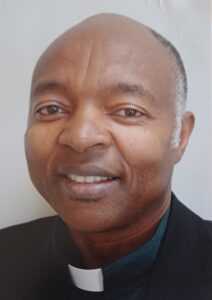
 Up to his last moment on earth, Fr. Fratern Masawe, S.J., never gave hopelessness a chance. The Masawe I saw in the morning before he died on Monday 19 October 2026 was the same person I first encountered in 1992, the only observable change being his physical weakness. Even after more than a year of poor health following heart complications and a stubborn sugar problem that resisted every therapy, his reassuring smile remained the same. He still mustered wise words even though his energy was failing him, and he still insisted on putting others first. In that morning, he finally yielded to my insistence that, after the long illness and because of the need to be in bed most of the time, we needed to change his wardrobe. Off I went to the market, obviously excited for this one score against a man who was determined to remain simple even while on hospital bed. When I came back in the evening with a bag full of new clothes, Baba Masawe—as we fondly called him—was no more.
In a way, Baba Masawe passed on exactly the way he lived. With a light touch, without noise, and never self-imposing, he might have spent seventy years on earth without leaving a trace. Yet, his simple style was so effective that he left positive marks on every person he met and on every ministry he undertook. “I wonder why so many people come to see me?” he asked me one day during his last days. Unsure what appropriate answer might be, I told him people came because they loved him. After his passing, I learnt that my answer was correct but significantly inadequate, for others had a lot more say.
Fratern’s family members spoke of loving senior brother they would remember fondly and miss dearly. Born on 1 August 1956 to Michael Kiwese Masawe and Yustina Mtemberi Kavishe at Mkuu, Rombo, in Tanzania, Fratern was the first of nine children. His immediate younger sister, Bibiana, died at a young age. He thus grew up with his four brothers (Fortunatus, John-Eudes, Marcel and Charles) and three sisters (Albertina, Lucia and Digna). His siblings looked up to him and, as they confirmed, always found wise support and peaceful reassurance from their elder brother.
At fifteen, Fratern left home to start a journey that would later lead him to the Society of Jesus. He attended Kilema Minor Seminary in Moshi (1971–1974) and Mazengo High School in Dodoma (1975–1976), and then completed mandatory National Service at Makutopora, Dodoma (1976 – 1977). He entered the Society of Jesus on 4 July 1978 at the novitiate in Lusaka, Zambia, thus starting a journey that lasted for 48 years. During that period he crisscrossed the world as he served the Church and the Society he loved. Rather fittingly, that journey ended in Rome, the very center of the Church and the Society.
During the long years of Jesuit formation and training, Fratern lived in Zambia, Ireland, Kenya, Belgium and the USA. Ordained priest on 28 June 1987, he went on to serve in various posts and positions. He was pastor at St. Francis Xavier in Mwanza, Tanzania (1990-1994), then helped establish the Jesuit Refugee Service (JRS) in north-western Tanzania in response to the refugee crisis that was triggered by the genocide in Rwanda (1994-1995). For many more years, Fratern served in various capacities in the internal administration of the Society.
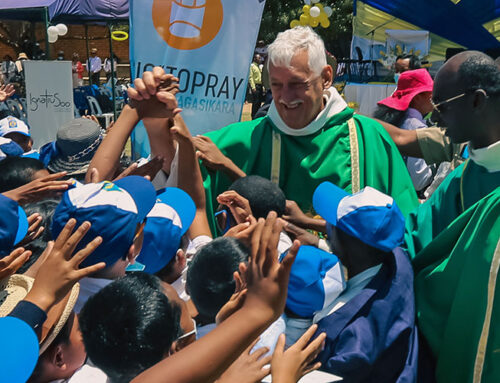
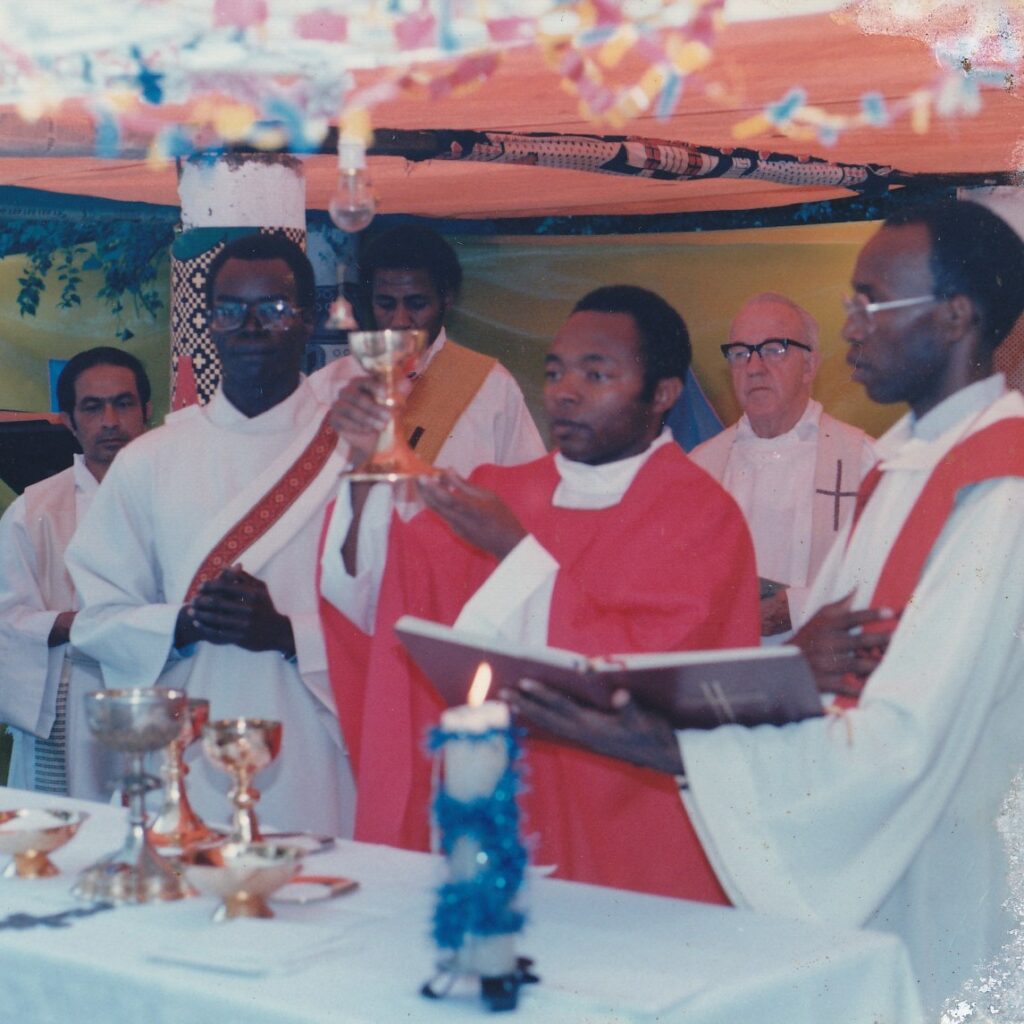 Fr. Fratern Masawe, S.J., first Thanksgiving Mass at Mkuu, 1987
When I met him in 1992, Baba Masawe was the Vocations Promoter for Tanzania, a role he played from 1989 to 1994. After completing his tertianship in Detroit, USA (1995–1996), he pronounced final vows on 8 December 1996. He then served concurrently as Socius to the Provincial of the Eastern Africa Province of the Society of Jesus and as the Provincial’s Delegate for Formation (1996 to 1998). In February 1998, he was appointed the first indigenous African provincial superior of the same province, an office continued to hold until 2004. He then served as Moderator of the Jesuit Superiors of Africa and Madagascar (2004-2011) before moving to Rome, his last destination.
Called to the Eternal City by Father General Adolfo Nicolás, S.J., in 2012, Baba Masawe served as General Councillor and Regional Assistant for Africa and Madagascar. The 36th General Congregation that elected Father General Arturo Sosa, S.J., in November 2016 also elected Fratern as one of four assistants entrusted with the care and support of the Superior General (assistentes ad providentiam). He held this latter office until his death on 19 October 2026.
Thus did Baba Masawe touch the world inside and outside the Society of Jesus. Those he touched remembered him when he was sick, prayed for him always, and visited him when they could. I still remember a young man named Joshua Ngimbwa, who came to visit the sick priest he had never met before because of the insistence of his parents in Tanzania. After Baba Masawe had passed on, several more people recalled his human warmth, wise counsel, and good works. Members of his home province highlighted his contribution to establishing Pedro Aruppe Community, the retirement home and care facility at Mwangaza in Nairobi, Kenya. In Africa more generally, his Jesuit companions recalled that it was when he served as Moderator for Africa and Madagascar that the Hekima Institute of Peace Studies and International Relations acquired its current premises at the Arrupe-Amani Riara Campus of Hekima University College and the conference headquarters were established at Karen in Nairobi, Kenya.
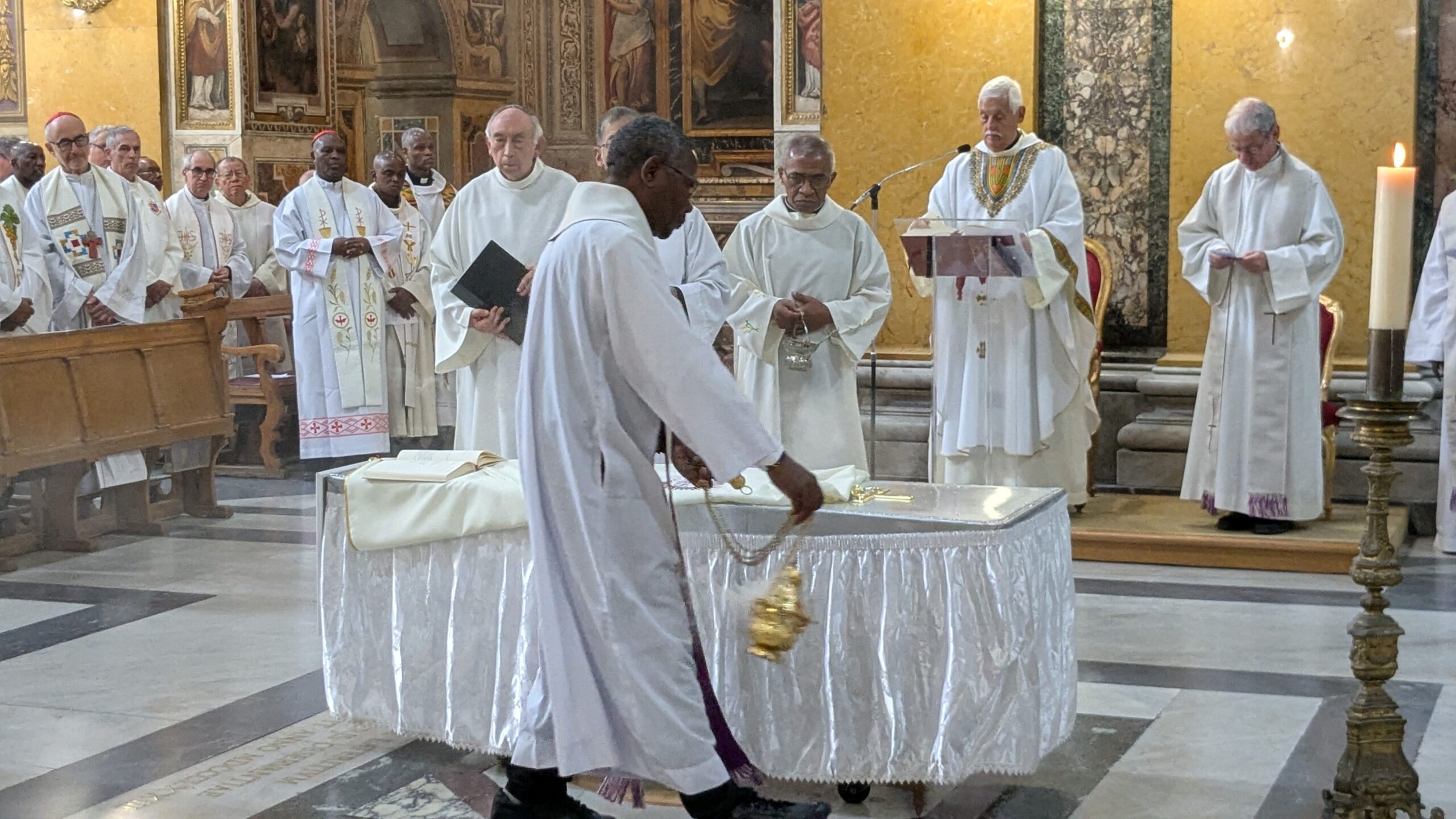
Thinking more globally, Fr. Sosa in his homily at Fratern’s funeral would thank God for “a companion, father, friend and brother” and “a man of God whom we may call with affection and respect—Baba Masawe.” Adding that Fratern “knew every corner of the apostolic presence of the Society in Africa and Madagascar, greeted each companion by name and welcomed the entire world with generosity,” Fr. Sosa called him “a universal African.” Looked at in this way, Baba Masawe takes the figure of one who stays alive and continues to serve beyond death because of the way he actually lived. Requiescat in pace, Fratern!
Festo Mkenda, SJ – Academic Director | Archivum Romanum Societatis Iesu