Reflecting on 16 Years of the Jesuit Historical Institute in Africa (JHIA)
As the Jesuit Historical Institute in Africa (JHIA) marks its 16th anniversary, we find ourselves reflecting not only on our own journey but on a global shift in how religious archives are perceived and utilized. The vision and mission of JHIA, to preserve the memory and heritage of the Society of Jesus in Africa, are part of a larger, international movement toward transparency and accessibility in religious documentation.
The transformation of religious archives from private, guarded repositories into accessible research centers is a pivotal development for historical scholarship. This shift is exemplified by a report from Fides regarding the Xujiahui Library in Shanghai. After being closed for a decade, this historic library, built by French Jesuits in 1867 and housing over 200,000 books and manuscripts, reopened its doors to scholars in the early 2003, and stayed open up to date.
The reopening of the Xujiahui Library, regarded as the oldest private library in modern Chinese history, highlights a growing global consensus: religious archives are not merely internal administrative assets but are vital pieces of the world’s cultural and historical fabric. As the library drafts regulations to balance conservation with public access, it mirrors the delicate work JHIA undertakes daily in Africa, preserving fragile histories while making them available for contemporary research.
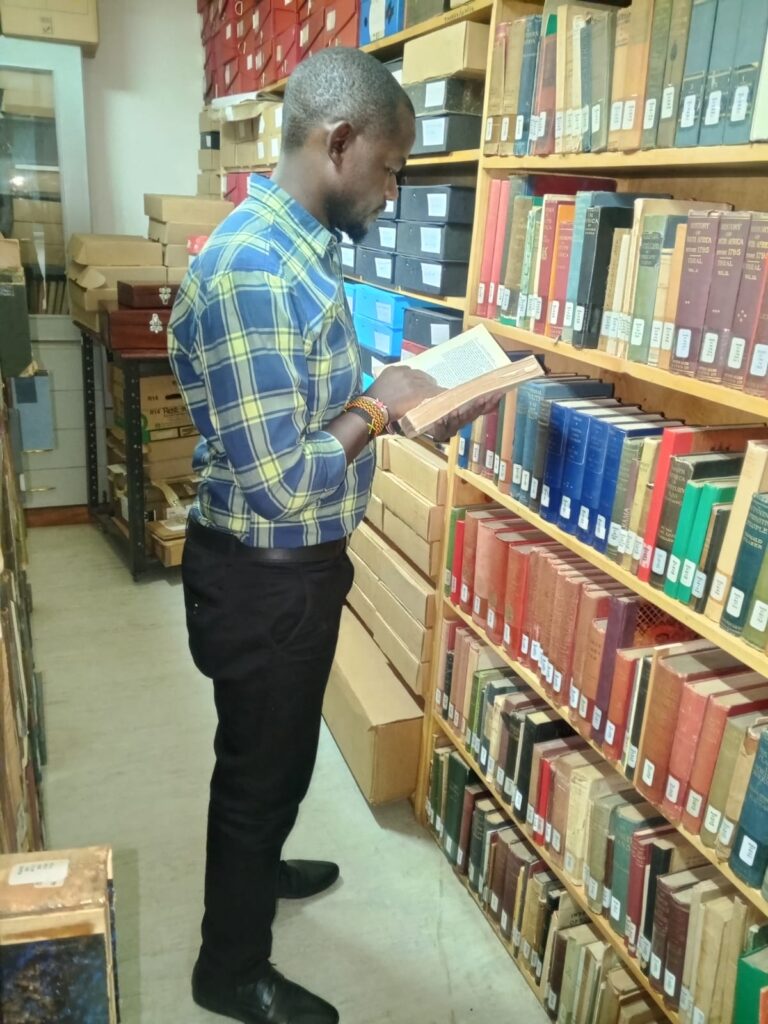 Alan Induswe – a library patron consulting some of the records at JHIA
This trend is further underscored by emerging academic research, such as the recent work, The Second World War through Jesuit Archives: The Case of Europe (1939–1945).
This study demonstrates how coordinated access to Jesuit records across multiple European provinces allows researchers to reconstruct the Society of Jesus’ complex experiences and responses during times of global conflict. It proves that when archives are made accessible through organized finding aids and institutional collaboration, the result is a richer, more nuanced understanding of history.
For faith-based universities and institutions like JHIA, these examples serve as a mandate. As noted by Burke et al. (2026), effective archival accessibility mechanisms are essential not just for administrative efficiency, but for safeguarding institutional memory and promoting transparency.
Reflecting on our 16 years of operation, the JHIA remains committed to this dual mandate of preservation and accessibility. By following the lead of international peers, from the reopening of the Xujiahui Library to the collaborative scholarship emerging from European Jesuit archives, we continue to ensure that the history of the Society of Jesus in Africa is not only preserved for the future but is actively contributing to the historical scholarship of today.
References
- JIVAN: News and Views of Jesuits In India May-June 2003.
- The Second World War through Jesuit Archives: The Case of Europe (1939–1945). By Damien Burke, Rebecca Somerset and Christian Taoutel. 2026.
Philip Opiyo – Librarian | JHIA