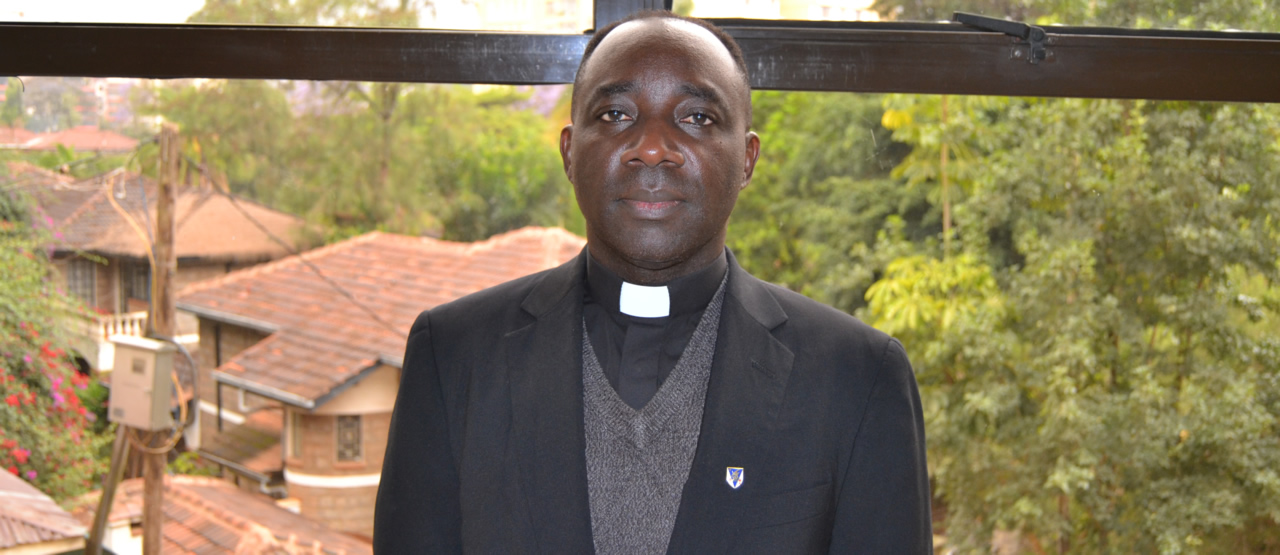
The past is never entirely behind us. It lives on in our memories, shapes our identities, and influences how we understand the world around us. For Fr. Nsielanga Tukumu Simon, SJ, exploring these connections is more than an academic pursuit; it is part of a lifelong commitment to faith, justice, and the search for peace. As he joins the Jesuit Historical Institute in Africa (JHIA) as a new member of JHIA, his journey brings a rich blend of pastoral experience, historical scholarship, and intellectual curiosity to the Institute’s mission.
Born on 9 November 1969 in Bundu, Democratic Republic of the Congo (DRC), Fr. Nsielanga entered the Society of Jesus in 1991. He pronounced his first vows on 8 August 1993. His formation and ministry have taken him across several African countries and beyond, including Rwanda, Cameroon, Kenya, Togo, Senegal, the United States, and Belgium. He studied philosophy at St Peter Canisius Philosophical Institute in Kimwenza, DRC, before undertaking regency at Libermann Jesuit High School in Douala, Cameroon, from 1996 to 1998. He later pursued theological studies at Hekima College in Nairobi and the Jesuit School of Theology in Berkeley, California. He was ordained a priest on 13 July 2008 at Sacred Heart Jesuit Parish in Gombe, Kinshasa, by Bishop Filibert Tembo, CICM, of the Diocese of Budjala. He pronounced his final vows in the Society of Jesus on 31 July 2020.
Over the years, Fr. Nsielanga has served in various educational and pastoral ministries, including as Director of Studies in Jesuit schools in the DRC, Director of Jesuit youth centres in Lomé, Togo, and Tambacounda, Senegal, and Vicar at St Peter Claver Parish in Tambacounda. These assignments have brought him into contact with diverse communities and experiences, deepening his engagement with education, youth formation, ethical leadership, and the challenges of building peaceful and just societies. His pastoral experience also includes refugee service in Kampala, Uganda, connecting his ministry with the realities of displacement and human vulnerability.
His academic interests in the history of decolonisation and social ethics reflect a desire to understand the forces that have shaped African societies and the values needed to build their future. His scholarly contributions span African history, political ethics, democracy, human rights, linguistics, and social responsibility. In his writings, he has examined traditional African ethical systems and their influence on good governance, the challenges of electoral democracy, political participation, and Africa’s engagement with wider social and political movements. His articles include “Éléments Éthiques d’Organisation de l’Afrique Traditionnelle et leurs Influences dans le Bon Gouvernement” (2011), “Pour une contextualisation africaine du système électoral à suffrage universel direct” (2011), and “L’Avenir du Forum Social Mondial: la Perspective Africaine” (2007).
His interest in human dignity and responsible leadership is equally evident in his writings on influential African figures. In “Towards an Ethics of Discipleship for the Modern World: Nelson Mandela, Desmond Tutu and Wangari Maathai,” published in Hekima Review in 2009, he explored the ethical significance of these leaders’ lives and witness. He has also written about Cheikh Anta Diop and human rights, as well as Congolese physician and Nobel Peace Prize laureate Dr Denis Mukwege, whose leadership and service have drawn international attention to the struggle for human dignity. His other publications range from an examination of the historical context of the 1517 Lutheran Reformation to philosophical reflections on the common good in Aristotle and St Thomas Aquinas. Alongside his academic writing, he has published literary and reflective works, including Peace For Africa/Paix Pour l’Afrique (2014) and Mots et odes à la Conscience (2019).
His scholarly interests extend beyond history and ethics to the preservation and study of African languages. In 2011, he collaborated with Thomas Grane and Larry Hyman on A Grammar of Nzadi: A Bantu Language of Democratic Republic of Congo, published by the University of California Press. The work reflects an important dimension of African historical and cultural scholarship: the documentation of languages as repositories of knowledge, identity, and collective memory.
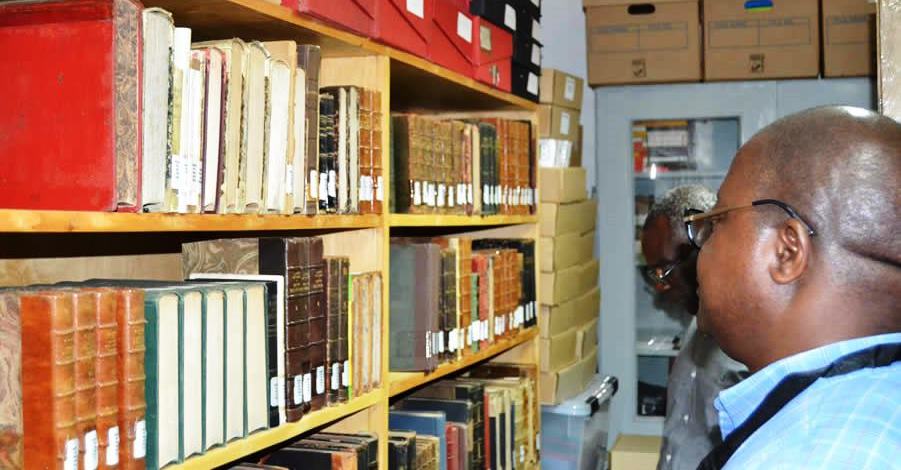
Fr. Nsielanga’s more recent research brings his interests in history, ethics, and memory into particularly meaningful conversation with the work of JHIA. In 2025, he co-authored “The Power of Silence: Congolese Religious’ Memories of the Colonial and Missionary Past,” published in The Memory of Power and Abuse of Power. The chapter examines the complex relationship between memory, colonial history, and missionary experience, raising questions about how religious communities remember and interpret their past. It also highlights the importance of listening to voices that may be overlooked in historical accounts. For JHIA, whose mission includes preserving and making accessible the historical heritage of the Society of Jesus in Africa, these questions are especially relevant. Historical collections are not simply repositories of old documents; they provide opportunities to recover experiences, examine difficult histories, and deepen our understanding of the people and communities that have shaped the continent.
His engagement with these themes extends beyond publications. Fr. Nsielanga has participated in a symposium on peacemaking at Hekima College in Nairobi and a conference in Bukavu, DRC, on the contributions and challenges of Congolese intellectuals in society. These engagements, together with his pastoral ministry and refugee service, reflect a consistent concern for the relationship between ideas and lived experience. His apostolic interests in peacemaking, reconciliation, and justice bring a practical and human dimension to his academic work, reminding us that understanding society also requires a commitment to improving the conditions in which people live.
Fr. Nsielanga is currently pursuing doctoral studies at KU Leuven in Belgium while serving as a member of JHIA in Nairobi. His arrival brings together a distinctive combination of Jesuit formation, educational leadership, pastoral experience, and scholarship on Africa’s historical and ethical traditions. As the Institute continues to preserve historical sources and support research into the history of the Society of Jesus in Africa, his interests in decolonisation, social ethics, and collective memory offer valuable perspectives for its work.
His journey reminds us that history is not merely a record of events that have passed. It is also a way of asking difficult questions, listening to forgotten voices, and understanding how the past continues to shape our shared future. Through his scholarship, ministry, and commitment to reconciliation, Fr. Nsielanga brings to JHIA a perspective that connects the study of history with the pursuit of justice and peace.
JHIA warmly welcomes Fr. Nsielanga Tukumu Simon, SJ, to the team and looks forward to his contribution to the Institute’s mission of preserving, studying, and sharing the historical heritage of the Jesuits in Africa.
Geoffrey Obatsa – Admin Assistant | JHIA.