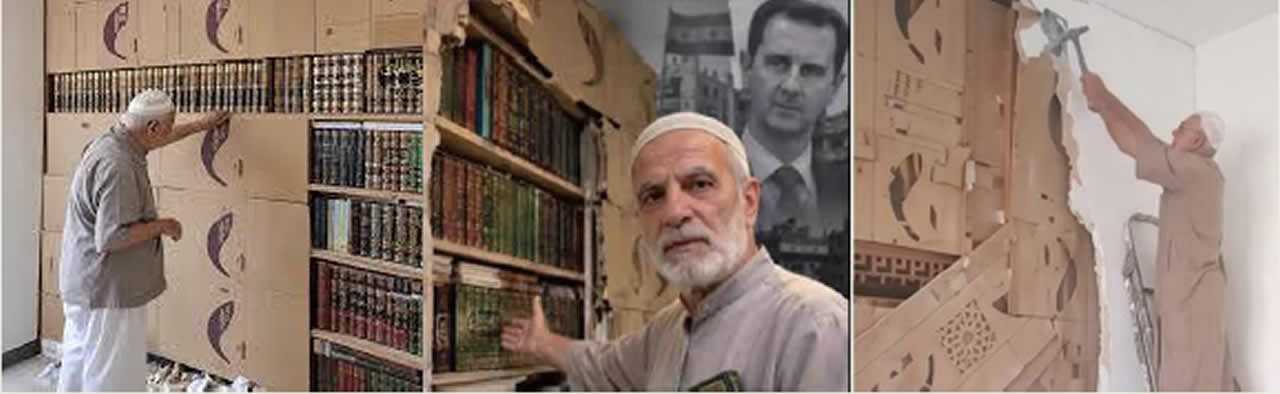
Abu Bilal’s Library Returns from the Shadows
When war comes, what do we choose to save? We often think first of human lives: escaping the bombs, crossing borders, finding shelter, protecting those we love. Yet war also threatens something less visible but equally precious – the memories, knowledge, and identities that give meaning to a life.
The story of a Syrian man known as Abu Bilal offers a remarkable reflection on this quieter struggle for survival. It is the story of a library hidden behind a wall for fifteen years – and of a man who returned to reclaim not only his books, but a part of himself.
A library buried behind a wall
In 2011, as Syria descended into war, Abu Bilal faced an agonizing choice. He knew that the books, rare manuscripts, certificates, and personal documents he had gathered throughout his life were in danger. In times of conflict, libraries and archives can become casualties of war, their contents destroyed, scattered, or deliberately erased.
So, Abu Bilal made an extraordinary decision. He built a wall. Brick by brick, he sealed his library behind concrete, turning the room into a hidden sanctuary for his intellectual and personal heritage. Then he left Syria, joining millions of others displaced by the conflict. He carried with him almost nothing – but he carried the hope that one day he might return.
For fifteen years, his library remained in darkness. Outside those walls, the world changed. Cities were destroyed. Families were separated. Lives were transformed by war and exile. But behind the wall, the books waited.
The return
Then came 2026. Abu Bilal returned home. The image of his return is striking. An older man, dressed in a white kufi and traditional thobe, climbs a precarious ladder. In his hands is a hammer. This time, however, it is not an instrument of destruction. It is an instrument of resurrection. He begins to break through the plaster and concrete of the wall he had built fifteen years earlier. And then, slowly, the past emerges.
The wooden shelves are still there. Hundreds of books, remarkably well preserved, stand where he left them. Manuscripts, certificates, and personal papers emerge from the darkness – the tangible traces of a life interrupted. For Abu Bilal, these were not simply books and documents. They were home.
More than books
There is something deeply moving about this story. In war, people can lose their homes, their possessions, their communities, and sometimes even the sense of who they once were. Refugees can quickly become numbers in reports and statistics in humanitarian records. But Abu Bilal refused to let his intellectual identity disappear. By hiding his library, he was doing more than protecting paper. He was preserving a part of himself – the scholar, reader, collector, and human being he had been before the war. He was keeping alive the possibility that, one day, he might return and reconnect with that life.
When the wall finally came down, he did not simply recover a collection of books. He recovered a piece of his memory. He recovered a part of his identity. He recovered a world.
Why memory matters
Abu Bilal’s story reaches far beyond the experience of one man. It reminds us why the preservation of historical memory matters – and why institutions dedicated to archives, documents, manuscripts, and historical research have such an important responsibility. This is also at the heart of the mission of the Jesuit Historical Institute in Africa.
Historical documents are never merely pieces of paper. They are fragments of memory. They preserve voices, experiences, relationships, decisions, struggles, and hopes. They allow one generation to speak to another. A document can be a voice. It can be an experience. It can be the trace of a life. And through these traces, we can come to understand the past more deeply.
This is why preserving archives, photographs, manuscripts, testimonies, and personal documents matters. Conflicts, disasters, the passage of time, and even simple neglect can lead to irreversible losses. Once a document disappears, the voice it carries may disappear with it.
Preservation, however, is not only about keeping documents safe. It is also about making them accessible. Cataloguing collections and digitizing records help protect historical sources while opening them to researchers, students, and future generations. In this way, preservation becomes an act of transmission: we give those who come after us the means to encounter, question, and understand what came before.
Keeping the past alive
For the Jesuit Historical Institute in Africa, this points to a deeper purpose: the development of a genuine historical consciousness. The past is not simply behind us. It continues to speak through the traces that have survived. Those traces can help us understand where we have come from, recognize the forces that have shaped our societies, and become more attentive to the lessons of history. They connect generations and help transform memory into knowledge. Abu Bilal built a wall to protect his past. Fifteen years later, he broke that wall down to recover it.
His story reminds us that sometimes preserving the past is an act of hope. We preserve because we believe that someone, someday, will need to remember. And perhaps this is one of the most important reasons why we preserve history: because what we save today may help another generation understand who it is tomorrow. The wall may have kept Abu Bilal’s library hidden from the world. But it also kept his world alive.
Philip Opiyo – Librarian | JHIA