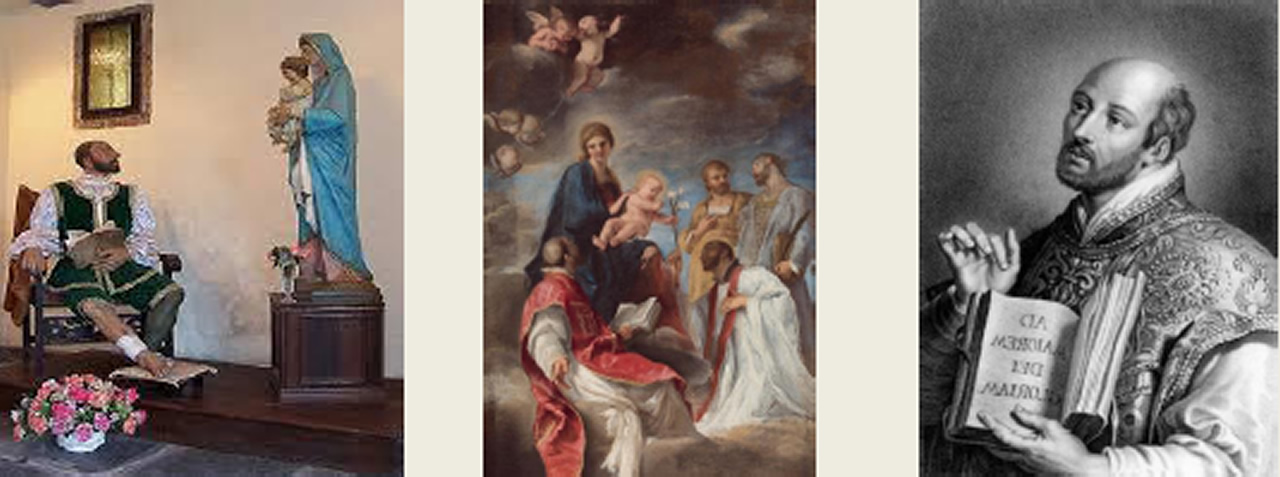
Mary in Ignatius’s Spiritual Journey
In the life of Saint Ignatius of Loyola, the Virgin Mary holds an important and deeply significant place. She is not simply a figure of devotion. She accompanied his journey of conversion, his prayer, and his desire to follow Christ.
The Roots of Marian Devotion
Saint Ignatius’s devotion to the Virgin Mary had its roots in his family environment. In fact, in the house of Loyola, there was an oratory containing a Flemish-style painting of the Annunciation. Here we can find the foundations of his relationship with the Virgin Mary. From childhood, Ignatius had been educated in Marian devotion. As a young man, Ignatius did not abandon this devotion. In particular, he would withdraw to one of the hermitages of the parish of Loyola dedicated to the Virgin Mary and known as Santa Maria de Elosiaga. There he prayed. Over time, this devotion would grow and become increasingly decisive in his conversion[1].
Our Lady of Olatz and the Journey of Conversion
The shrine of Our Lady of Olatz, near Azpeitia, was also a privileged place in Saint Ignatius’s spiritual journey. During his convalescence, as soon as he was able to stand on his feet with the help of crutches, he took short walks to the shrine of Olatz. According to tradition, standing on his crutches, Ignatius would greet Our Lady of Olatz[2]. Thus, from Loyola to Olatz, Mary was a witness to Ignatius’s journey of conversion at a time when he was undergoing a profound spiritual experience.
Aranzazu: A Decisive Act of Consecration
Once he had recovered, it was at the shrine of Aranzazu in 1522 that Ignatius made a vow of chastity during a night of prayer. There he made the personal and radical choice to consecrate his life to God and to direct his existence towards Christ. The Marian shrine thus became one of the Ignatian places where the transition from the old Inigo to the new Ignatius was manifested. Ignatius chose the Marian shrine as a place of prayer and decision at a moment when his life was taking a new direction[3].
Montserrat: From Knight to Servant of Christ
In his Autobiography, Saint Ignatius also recounts his passage through Montserrat in 1522. This episode marked an important stage in his journey of conversion. At the foot of the altar of the Black Madonna of Montserrat, he laid down his weapons during a night vigil of prayer. This was another decisive moment. Ignatius abandoned his former life as a knight and began a life as a soldier of Christ. From then on, his struggle would be of a different nature. He would no longer seek personal glory, but the service of God. This scene summarizes something essential in Ignatian spirituality: renouncing what confines us and our disordered attachments in order to become more available to what God wishes to do with our lives. The Virgin Mary becomes a presence that leads to Christ.
Marian Devotion and the Growth of Discernment
From his devotion to the Virgin Mary, Ignatius firmly believed in the doctrine of the Immaculate Conception. At the beginning of his conversion, in order to defend the honour of the Virgin, he was even ready to kill a Moor who questioned Our Lady’s virginity. This story reveals the attitude of the newly converted Ignatius: he had become a man animated by great religious zeal. But he was also still a man on a journey of discernment. Gradually, he would move from spontaneous zeal to discernment; from the desire to defend his faith immediately to the search for the right way to serve the mission of Christ[4].
Mary as Intercessor and Guide to Christ
Saint Ignatius also believed in the intercessory power of the Virgin Mary. In the Spiritual Exercises, he frequently presents Our Lady as an intercessor between the retreatant and Christ. Mary leads to Jesus. Indeed, the triple colloquy begins with Mary before moving to Christ and then to the Father[5]. Purified by his spiritual experience, Saint Ignatius became more discreet in his Marian devotion[6]. When he arrived in Paris in 1528 for his studies, he had most likely experienced the event of the desecration of a statue of the Virgin Mary. This took place in a context in which religious images had become a major issue in the conflict between Catholics and Protestants. The desecration provoked a strong religious and political reaction. Francis I, King of France, organized a ceremony of expiation. Processions and prayers accompanied this act of reparation. There is no evidence of any particular action by Saint Ignatius during these acts of reparation. But if this had occurred during the time of his conversion, what could the pilgrim of Our Lady of Montserrat have done during such events? Apparently, the Lady whose honour Ignatius had once defended had now become, rather, the one who leads to Christ. It was a new way of seeing things.
Mary, Availability, and the Service of Christ
Saint Ignatius’s devotion to Mary does not lead him away from Christ. With Mary, Saint Ignatius learned to say “yes” to God, and he knew how to place himself at the service of Christ. He learned to lay down his weapons in order to become more available to God. At the school of Mary and Saint Ignatius, we discover that true greatness does not consist in controlling everything, but in making oneself available to God. And availability can become a very simple prayer: “Take, Lord, and receive all my liberty, my memory, my understanding, and my entire will, all that I have and possess. You have given all to me; to you, Lord, I return it. All is yours: dispose of it wholly according to your will. Give me only your love and your grace; that is enough for me. Amen!”[7]
Jean-Paul SAVI – Director | JHIA
[1] Thamburaj, Ignatius and Mary, in JIVAN, March 2023, 18.
[2] Thamburaj, Ignatius and Mary, in JIVAN, January 2023, 18
[3] Thamburaj, Ignatius and Mary, in JIVAN, January 2023, 18
[4] Thamburaj, Ignatius and Mary, in JIVAN, March 2023, 18.
[5] Exercices Spirituels, n°147.
[6] Thamburaj, Ignatius and Mary, in JIVAN, May-June 2023, 18.
[7] Exercices Spirituels, n°234.