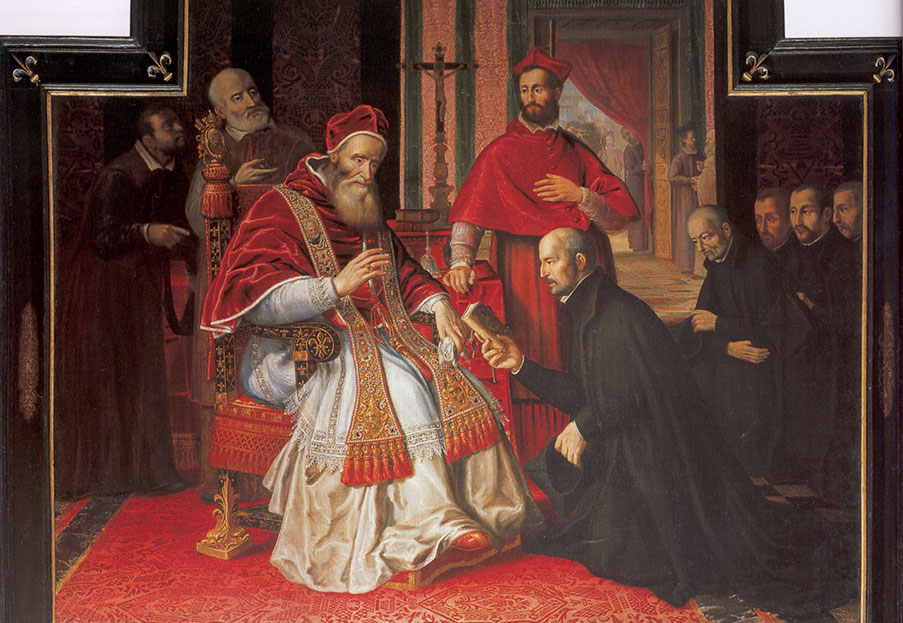
From its very foundation, the Jesuits have placed themselves at the service of the Pope, offering their service for the universal mission of the Church. This defining characteristic, rooted in the vision of St Ignatius of Loyola, is not merely a spiritual ideal but a concrete commitment. It is a tradition of availability and obedience that has continued unbroken through the centuries and remains a hallmark of Jesuit identity.
The Society of Jesus was founded in 1540, in the midst of the great religious crisis of the 16th century. It was also the end of a series of Renaissance Popes, characterised more by their political, even worldly activities (Alexander VI, Julius II, Leo X…), than by their spiritual leadership; although the latter took the necessary reform of the Church seriously (Paul III, Julius III, Pius V…). Despite this diversity, which was not always edifying, Ignatius of Loyola and his first companions bound the nascent order to the Pope with a vow of obedience, as agreed in the deliberations of 1539: it was more appropriate for the Vicar of Christ ‘to dispose of us and send us where he judges we can be most fruitful’, since, according to Peter Faber, ‘he knows best what is best for universal Christianity’. This is the origin of the fourth vow (other religious congregations have something similar) characteristic to the Jesuits – their ‘identity’ – which is added to the three vows of religious life: poverty, chastity and obedience. This does not mean that Jesuits must obey the Pope more than any other Catholic, but rather that, by that vow, Jesuits place themselves at the disposal of the Pope to carry out the missions entrusted to them.
One of these ‘missions’, granted by Paul III at the request of King João III of Portugal, was to evangelise the East Indies, for which the Portuguese national Simão Rodrigues and the Spaniard Nicolás de Bobadilla were assigned. However, it was St Francis Xavier who ended up going, even before the canonical foundation of the Society. John O’Malley asserts that it was Saint Ignatius and the first Jesuits who changed the semantics of the term ‘mission’, starting from ‘sending’ [by the Pope] to referring to apostolic work among non-Christians as a consequence of that sending.

The Popes of the 16th century made special use of the availability of the Jesuits: on several occasions, Paul III sent Jesuits as papal envoys (Ireland), preachers, teachers (Sapienza), reformers or missionaries. Julius III entrusted them with the German College, sent Diego Laínez and Jerónimo Nadal to negotiate with the German Protestants, Laínez and Nicolás Salmerón as theologians to the Council of Trent, and other Jesuits to Corsica and Piacenza, as well as to Ethiopia. Paul IV sent them to Poland and Brussels, and Pius IV to Ireland and Scotland. Pius V asked the Jesuits to be confessors (penitentiaries) at St Peter’s Basilica (1569) and appointed a Jesuit as nuncio to Scotland. Gregory XIII founded the Roman College (later the Gregorian University) and sent Jesuits to Constantinople, Lebanon, Sweden, Scotland and Scandinavia. Probably the last personal papal mission before the suppression of the Society (1773) was the appointment of Fr M. de Azevedo by Benedict XIV as consultant to the Congregation of Rites in 1748, which from then on would always include a Jesuit.
After the restoration of the Society (1814), we find papal missions, but these concern institutions rather than specific individuals: Urban College (Rome) 1836; Civiltà Cattolica, 1866; Leoniano Regional Seminary (Anagni), 1897; Pontifical Biblical Institute (Rome), 1909 and College in Manila, returned to the Society in 1910; Pontifical Oriental Institute (Rome), 1922; Colleges in Rome: Russian (1929), Maronite (1931), Brazilian (1934); parishes in Rome, such as San Saba (1931); a permanent minor penitentiary in St Peter’s Basilica (1931); Castel Gandolfo Observatory (1935), etc.
One of the last assignments was that of Paul VI to the 31st General Congregation, inviting the Society to focus its apostolic energies on the fight against atheism, a mission supported by the Congregation itself and by the newly elected General, Fr Pedro Arrupe.
Throughout its history, the Popes have counted on the Society of Jesus, entrusting it with specific missions. This fourth vow of obedience to the Pope circa missiones – although it does not exhaust the availability and service of the Jesuits to the Holy See – remains the most central part of their DNA, in the past, present and future.
By Wenceslao Soto Artuñedo, SJ
Archivum Romam Societatis Iesu (ARSI)