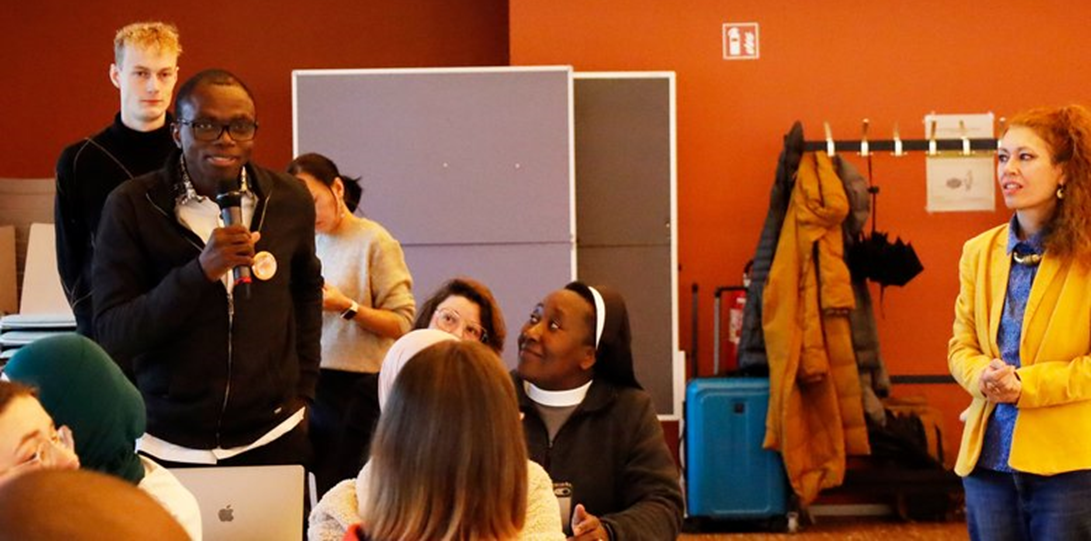
From 12 to 14 January 2026, I had the privilege of participating in an international symposium hosted by the Catholic University of Applied Sciences North Rhine-Westphalia (Paderborn) and the Mission House in Neuenbeken. The conference, Communicating Missionary Collections through Artistic Methods: Opening Spaces, Moving Together, Seeking Dialogue, marked the first major public milestone of a three-year research project launched in 2025. The gathering brought together scholars, artists, museum practitioners, theologians, educators, and social workers from across the globe. For me, it was a rare chance to step into a rich interdisciplinary space, sharing reflections and learning from others about missionary collections, colonial entanglements, and ways of fostering care, dialogue, and responsibility today.
Conference Framework and Objectives
The symposium centered on a question that resonates deeply with the work of JHIA: how can missionary collections, especially those shaped in colonial contexts, be approached ethically and dialogically today? Rather than seeing collections as frozen in the past, the conversations emphasized movement—of objects, meanings, memories, and relationships. Artistic and performative methods were not just supplementary but central: they became tools for opening new spaces of encounter, challenging inherited narratives, and encouraging reflection.
Over three days, the discussions were organized around four themes: international and local cooperation; women in mission; experimentation through artistic mediation; and imagining futures. I found the sessions particularly engaging because they intertwined questions of appropriation, restitution, feminist perspectives, postcolonial critique, global learning, and the ethics of sustaining missionary collections responsibly into the future.
Key Insights and Experiences
One theme that stayed with me was the notion of “travelling objects.” It was fascinating to explore how objects, when displaced across continents and generations, carry shifting meanings and values. I was struck by how speakers emphasized their mobility—not just physical, but symbolic—and the ethical implications of losing contextual knowledge. For me, this lens offered a fresh way of thinking about missionary collections, where objects are never neutral, and their movement is inseparable from histories of power, evangelization, and cultural exchange.
Another memorable experience was the postcolonial walking tour of Paderborn, led by the City Museum in collaboration with the University. Walking through the city, tracing overlooked colonial connections—missionary activity, ethnological exhibitions, and colonial goods—made history tangible in unexpected ways. It reminded me that education and reflection can emerge from spaces beyond libraries or lecture halls.
Artistic methods were woven throughout the symposium in ways that were both playful and deeply serious. Theatre workshops, participatory music sessions, and even shared cooking experiences were presented not as outreach activities, but as ways of knowing and reflecting. I was especially moved by workshops that engaged personal objects and life stories to explore encounters across cultural, religious, and historical differences. These experiences showed me how art can hold complexity, ambiguity, and vulnerability—qualities that academic writing alone can rarely convey.
Women, Mission, and Feminist Perspectives
A strong highlight for me was the focus on women in mission, particularly the collection of the Missionary Sisters of the Precious Blood in Neuenbeken. The sessions illuminated the often-overlooked roles of these religious sisters—as collectors, educators, artists, and mediators—and brought feminist perspectives to the fore. Hearing about their creativity, resilience, and ethical navigation of colonial structures offered me new ways to think about agency, care, and social engagement in mission history. The discussions encouraged me to see missionary collections not simply as artifacts of the past, but as resources that can speak to contemporary debates on justice, dignity, and sustainability.
My Contribution: Archives as Spaces of Responsibility
I presented a paper titled Opening Spaces of Responsibility: Jesuit Missionary Archives in Africa between Memory, Power, and Shared Future. Drawing on the Jesuit Historical Institute in Africa as a case study, I approached archives not simply as repositories, but as morally charged spaces shaped by historical power dynamics. I argued for an ethic of archival care—attending to access, context, and the consequences that archival decisions have for communities represented within these collections.
Beyond my paper, I found the discussion energizing. Participants noted parallels between artistic mediation and archival care, especially their shared focus on context, relationship, and ethical attentiveness. For me, it was a vivid illustration of the power of interdisciplinary dialogue, and it reaffirmed why spaces like this symposium are so important.
Concluding Reflections
The Paderborn symposium left a strong impression on me. It was more than a series of presentations; it was a living, dialogical space where critique, imagination, and embodied practice came together. Its insistence on movement—of objects, people, and ideas—challenged me to rethink inherited categories and the responsibilities we carry when engaging with missionary collections.
In a time when decolonization, restitution, and the ethics of memory are urgent global conversations, the symposium offered a hopeful model: a way of engaging the past with honesty, care, and openness to transformation. I left Paderborn inspired, challenged, and more committed than ever to exploring how archives, collections, and art can serve as spaces for dialogue, responsibility, and shared futures.
By Norbert Litoing, SJ
Interim Director – JHIA