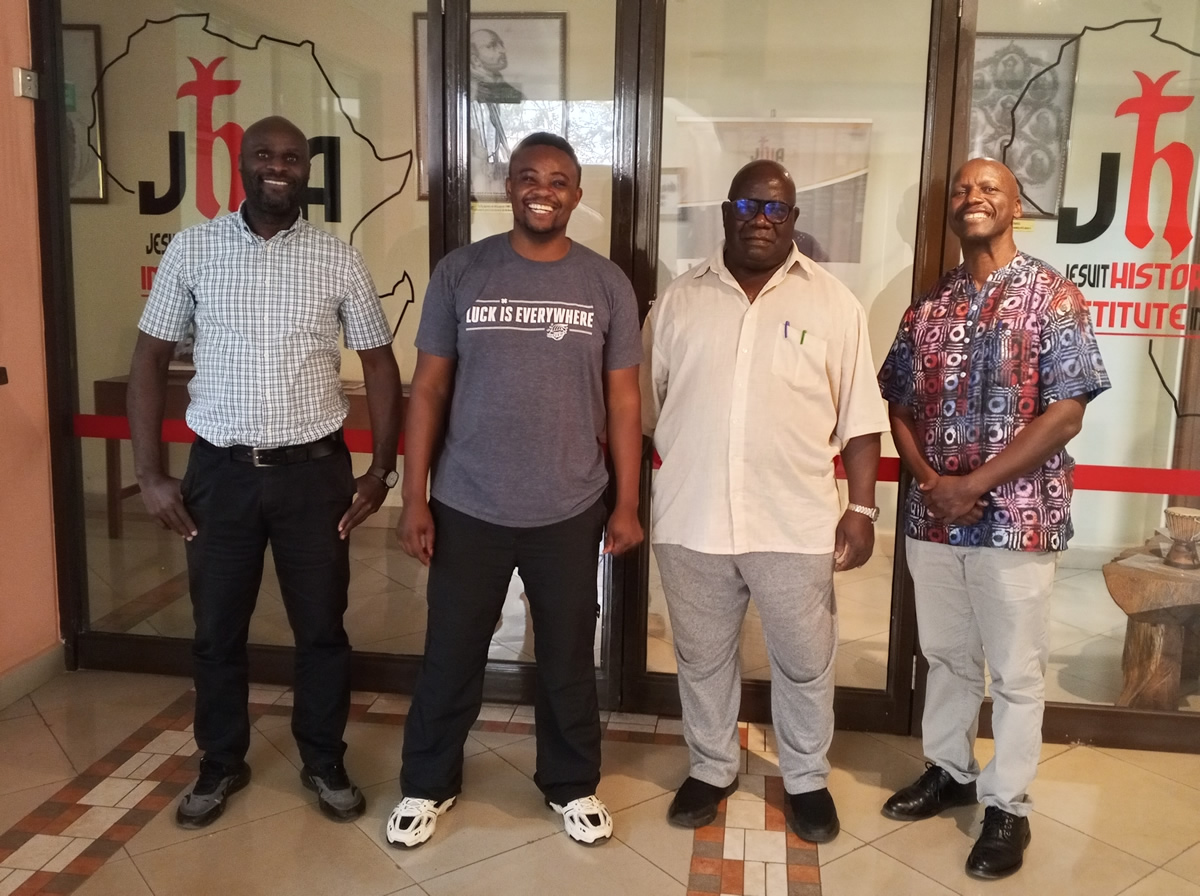
The Jesuit Historical Institute in Africa (JHIA) was privileged to welcome Fr Fidelis Mukonori, SJ, during his recent visit to Nairobi. Accompanied by Fr Kizito Kiyimba, SJ, Provincial of the Eastern Africa Province, Fr Mukonori was in Kenya principally to participate in the joyful celebration of the Final Vows of Fr Francis Anyanzu, SJ, and Fr George Macharia, SJ. As a seasoned Jesuit and former Provincial of Zimbabwe, Fr Mukonori brought to the occasion the wisdom and experience of a life dedicated to the service of the Church and the Society of Jesus commonly known as the Jesuits.
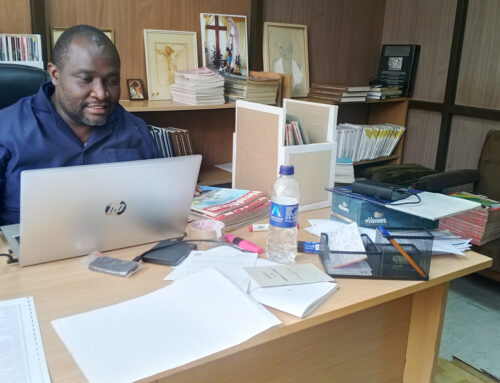
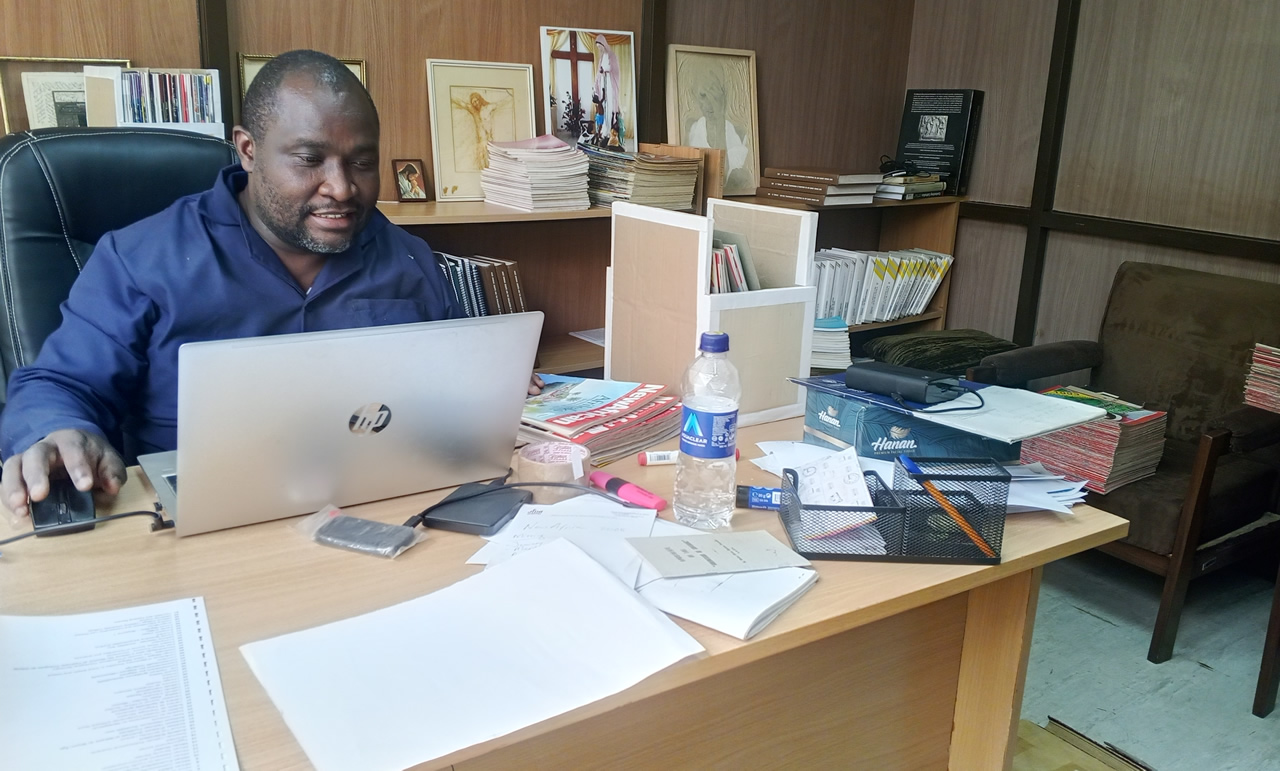
His courtesy visit to JHIA provided a cherished opportunity to reconnect with the Institute and its mission of preserving and promoting the rich heritage of Jesuit history in Africa. Together with Fr Kizito Kiyimba, SJ, he enlivened conversations with vivid recollections of landmark moments in the history of the Church and the Society of Jesus. Their narration of the story of the Uganda Martyrs and of Fr Pedro Arrupe, SJ, captivated JHIA staff with such immediacy and depth that one could almost imagine them as eyewitnesses to those defining events. Their visit also proved invaluable to the Institute’s archival work, as they assisted in identifying and contextualizing several historical photographs preserved at JHIA.
Over the decades, Fr Mukonori has distinguished himself as a pastor, educator, administrator, and mediator, serving the Society and the people of Zimbabwe with remarkable dedication. His witness to faith, leadership, and reconciliation continues to inspire generations of Jesuits and collaborators alike. The following biographical sketch highlights some of the milestones and ministries that have marked his long and fruitful apostolic journey.
Born on 15 July 1947 in Mazowe, 50 km north of Harare, Fidelis did his primary education at Chishawasha, the second oldest Jesuit mission in Zimbabwe. On finishing his education, he worked as a catechist for a while before joining the Society as an ‘indifferent’ in Lusaka in 1971. After his vows as a brother, he returned to Zimbabwe (then Rhodesia) and did further catechetics courses at Hwange in the far west of the country and at the regional Seminary in Chishawasha. He combined his studies with helping in administration at the Seminary and then worked for a short time at St Peter’s Mbare as a pastor.
Br Fidelis then moved to Silveira House, also in Chishawasha, where he developed an Archdiocese-wide youth program building on one group in Mabvuku, a suburb of Harare (then Salisbury). Misereor generously funded the programs at Silveira House and Fidelis was able to animate the formation of 194 groups involving 2,500 young people. It was war time and any gathering of young people was suspect to the security forces and also the guerrillas, fighting for freedom, who questioned the youth about their allegiance. Fidelis, and the team of helpers he trained, were fearless in his ‘shepherding’ of these young people in their care who were often scared by the way they and their families were caught in the middle of the conflict.
At the same time Fidelis became involved in the Catholic Commission for Justice and Peace and was able to feed into the commission his knowledge of what was happening in the rural areas. The CCJP included him in a number of missions to London and New York as well as to the Nationalist leaders in exile in an effort to bring about peace.
Tertianship followed in Spokane in 1981 and in the following year he returned to continue his youth work, this time in a free Zimbabwe. During this period in the 1980s, Fidelis gave serious consideration to a desire that was coming to the fore in his mind; to apply to become a priest. His application to change from brother to priest was approved and he returned to the Seminary to study philosophy in 1987. Theology followed in Nairobi in 1989 and he was ordained in 1991 in the presence of President Robert Mugabe whom he had come to know in his work in CCJP.
As a priest he served in an urban parish, Mabelreign, from 1988 till he went to Marymount far out in ‘the bush’ in 1992. In 1994, he became minister at Arrupe – first the house, then the college – before going to the Cathedral as assistant pastor in 1996. He returned to his old work at Silveira with the youth in 1998 up to the time when he was appointed provincial 2002-08. He was the first locally-born provincial in our province and, on the side, he received many Diplomatic visitors who wished to learn from him about the situation in the country and its history in the liberation struggle.
At the end of his time in office, he went to a newly founded parish in Marlborough, a suburb of Harare where he remained until, in 2010, he went as superior to Chishawasha mission where he had done his primary education many years before. He then moved to Makumbe Mission before retiring to Harare some ten years ago. He continues to be involved with the political leaders in the country, offering advice when called on.
Fidelis has also taken up writing since the Sabbatical he had in Berkeley, California, where he did a Master’s thesis, Democracy and Development, an Ethical Perspective (1997). He also wrote on his war experience in two books, The Genesis of Violence in Zimbabwe, The Centre for Peace Initiatives in Zimbabwe, (2012 and a revised edition in 2015). And in 2017, Man in the Middle – a Memoir, House of Books, appeared.
Fr Virgílio Costa SJ
Socius / Assistant to the Provincial Jesuit Province of Southern Africa
Geoffrey Obatsa (Contributor)
Admin Assistant, JHIA